
Results of a research of the international SHADOW project presented in Bishkek
According to the results of the SHADOW project, the level of the shadow economy in Kyrgyzstan is 42% of GDP.


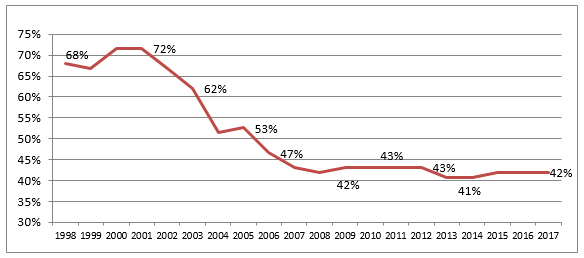
According to the results of the SHADOW project, the level of the shadow economy in Kyrgyzstan is 42% of GDP.
The research was conducted as part of the SHADOW project (12 countries) with the support of the Horizon 2020 program of the European Union.
SHADOW is a research and training program aimed at producing strategic intelligence in the region and training a generation of specialists on informality in post-Soviet spaces.
What encourages participation in the informal economy of Kyrgyzstan? To what degree can we estimate the size of its Shadow economy?
In 2019 SIAR research & consulting has conducted a study to calculate the index of the shadow economy, based on the methodology developed by Putniņš and Sauka (2015). The methodology allows to compare the results in the Kyrgyz Republic to other shadow economies (Ireland, Romania, Moldova, Sweden, Estonia, Latvia, Lithuania, Georgia, Russia, Ukraine and Uzbekistan).
This research primarily focuses upon the aspects of Kyrgyzstan’s shadow economy between 2017 and 2018 in order to provide relevant and contemporary results.
The research authors believe that discussion of its results at different levels, involving all stakeholders would be useful for policy-making and decision-making, aimed at overcoming the problems of the shadow economy.
The level of the shadow economy in Kyrgyzstan (% of GDP)
Biography:
Dr. Abel Polese is a senior research fellow at the Institute for International Conflict Resolution and Reconstruction, Dublin City University, Ireland. He has been Principal Investigator of SHADOW a four year project starting in 2018 funded through Marie Curie RISE (H2020).
Ainura Sagynbaeva is a founder and director of SIAR research & consulting (1998), one of the leading research companies in Central Asia and Mongolia. She has over 35 years of international experience in the field of various research, surveys and counseling. She is a member of ESOMAR and the National Monitoring and Evaluation Network in Kyrgyzstan, a member of the board of the KURAK Women's Forum.
News
IBC Highlights Key Business Concerns Regarding Proposed Tax Code Amendments
On October 12, 2026, Askar Sydykov, Executive Director of the International Business Coun…
IBC Participates in the Meeting of the Statistics Council of the Kyrgyz Republic
On October 6, IBC Executive Director and Deputy Chair of the Statistics Council Askar Syd…
IBC Presented Its Approaches to Advancing Business Interests at the CIPE Regional Conference
IBC presented Kyrgyzstan’s experience in business advocacy at the CIPE regional conferenc…
From Dialogue to Projects: Central Asia–Central Europe Cooperation Discussed in Prague
On September 19, IBC Executive Director Askar Sydykov participated in the international c…