
IBC News
ESG Is No Longer Theory — It's Business Reality
On May 13, the International Business Council, together with Ernst & Young (EY), held a seminar on implementing ESG and non-financial reporting in Central Asia, bringing together representatives from the financial sector, audit and consulting firms, and manufacturing companies that are IBC members.


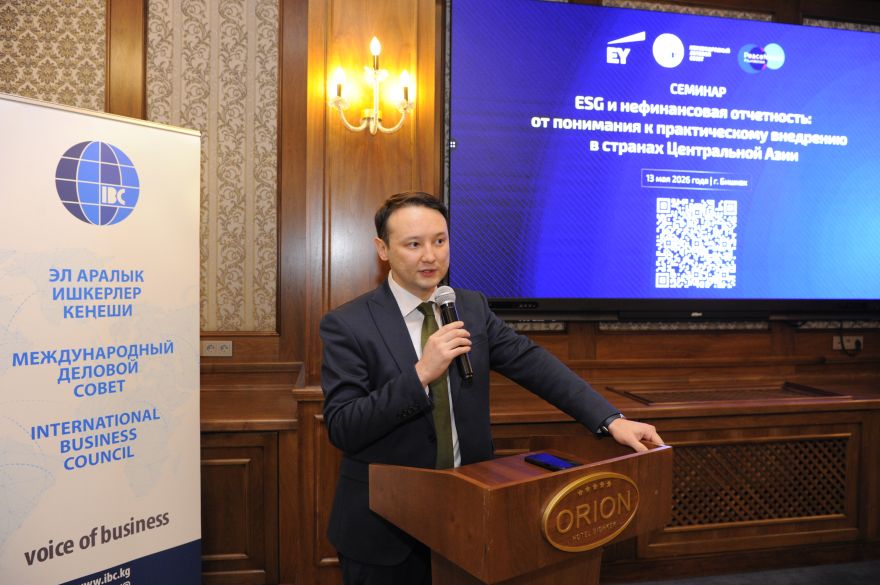
Today, May 13, at a seminar hosted by the IBC and Ernst & Young (EY), experts discussed practical approaches to implementing ESG and non-financial reporting in Central Asian countries. The adoption of ESG principles (environmental, social, and corporate governance) in Central Asia is gradually shifting from a voluntary initiative to a practical requirement set by investors, banks, and international partners. For business, ESG is becoming not just a reputational issue but also part of a company's risk management system and long-term sustainability. The relevance of this topic is confirmed by the results of a survey conducted by the International Business Council among its member companies. The survey involved 40 companies representing key sectors of Kyrgyzstan's economy. Companies cited reputation and image, environmental concerns, and reduced risks and costs as the main drivers behind ESG adoption. At the same time, businesses identified the absence of national ESG standards, a shortage of practical expertise, and a limited number of local ESG implementation cases as key barriers. In response to this demand from business, the IBC is working to develop practical tools for ESG implementation in Kyrgyzstan. In particular, at the association's initiative, the international standard ISO 14005:2019 — which sets out a phased approach to implementing environmental management systems — was adopted as a national standard of the Kyrgyz Republic. The Ministry of Economy and Commerce of the Kyrgyz Republic is also working, as part of the Green Economy Development Program through 2029, to build a national system for implementing sustainability (ESG) principles. It was precisely this growing business demand for practical ESG implementation tools and applied approaches to non-financial reporting that prompted the seminar "ESG and Non-Financial Reporting: From Understanding to Practical Implementation in Central Asia," held today, May 13, by the International Business Council together with Ernst & Young (EY), whose specialists provide a full range of audit, consulting, tax, strategy, and transaction services in more than 150 countries worldwide. The event was held with support from the PeaceNexus Foundation and brought together more than forty representatives from the financial sector, audit and consulting firms, and manufacturing companies that are IBC members. Participants discussed how the logic of presenting financial results is changing, what exactly companies will need to disclose regarding sustainability and climate, and how companies can prepare to adopt international standards without unnecessary risk. Special attention was given to how ESG is gradually becoming part of corporate governance and management decision-making. Opening the meeting, IBC Executive Director Askar Sydykov emphasized: "The International Business Council constantly strives to bring new technologies and best business practices into Kyrgyzstan's entrepreneurial environment. That's why this time we brought in leading ESG experts and organized a free seminar for association members, which will improve local businesses' access to best practices and continue building a sustainable ESG community in the country. We also hope these practices will strengthen our businesses' resilience to internal and external risks and improve entrepreneurs' access to financing." Welcoming remarks were delivered by Omurbek Kenzhebaev, Head of the Department of International Financing, Green Economy, and Tourism at the Ministry of Economy and Commerce of the Kyrgyz Republic, and Kanatbek Abdiev, Program Officer of the PeaceNexus Foundation in Kyrgyzstan. Roman Dovolnov, Senior Manager at Ernst & Young (Uzbekistan), presented an overview of the key drivers behind ESG and non-financial reporting development, including the requirements of investors and financial institutions, access to financing, and the impact of ESG on business model resilience. The expert spoke about the role of ESG as a tool for risk management and boosting business competitiveness. Ruslan Sadgalin, Senior Manager at Ernst & Young (Kazakhstan), spoke about the IFRS S1 and IFRS S2 standards, their role in the international system for sustainability disclosure, and their importance in establishing a unified, investor-friendly language for ESG reporting. Participants also discussed the impact of ESG factors on companies' financial stability, investment decisions, and the creation of long-term business value. During the practical portion of the seminar, case studies on ESG implementation and non-financial reporting preparation were presented, along with an analysis of common mistakes and successful approaches at the early stages. Experts emphasized that a phased, applied approach to ESG implementation is especially important for companies in Kyrgyzstan. Participants discussed practical approaches to preparing ESG disclosures, organizing data collection systems, integrating ESG into business processes, and developing internal ESG implementation roadmaps. Special attention was given to the growing role of ESG in Central Asia's financial sector. Banks and financial institutions in the region are already integrating ESG approaches into lending and risk assessment processes, and stock exchanges are gradually adopting recommendations for ESG disclosure. Aliya Baimaganova, Advisor to the Chairman of the Board of the Association of Environmental Organizations of Kazakhstan, presented case studies on environmental and social Impact Assessment and spoke about the risks of greenwashing, emphasizing the importance of moving from formal ESG declarations to measurable, verifiable results. Aidar Kazybayev, President of the International Institute of Management and Audit and founder of Global ESG Partnership (Kazakhstan), shared Kazakhstan's experience in developing green financing and ESG transformation, noting that ESG is today becoming a factor in competitiveness, access to capital, and business risk management. Summarizing the meeting, participants emphasized that ESG transparency is gradually becoming part of a new infrastructure of trust for business, already influencing access to financing, investment attractiveness, and company competitiveness. Following the summary, certificates were presented to participants.
News
IBC Highlights Key Business Concerns Regarding Proposed Tax Code Amendments
On October 12, 2026, Askar Sydykov, Executive Director of the International Business Coun…
IBC Participates in the Meeting of the Statistics Council of the Kyrgyz Republic
On October 6, IBC Executive Director and Deputy Chair of the Statistics Council Askar Syd…
IBC Presented Its Approaches to Advancing Business Interests at the CIPE Regional Conference
IBC presented Kyrgyzstan’s experience in business advocacy at the CIPE regional conferenc…
From Dialogue to Projects: Central Asia–Central Europe Cooperation Discussed in Prague
On September 19, IBC Executive Director Askar Sydykov participated in the international c…